
I’ve been thinking about how engineering personality types have changed over time. Not skills. Shapes. The way someone’s expertise is structured, and how that structure has to change again for the AI moment we’re in now.
There are four shapes I keep coming back to.
The Four Shapes
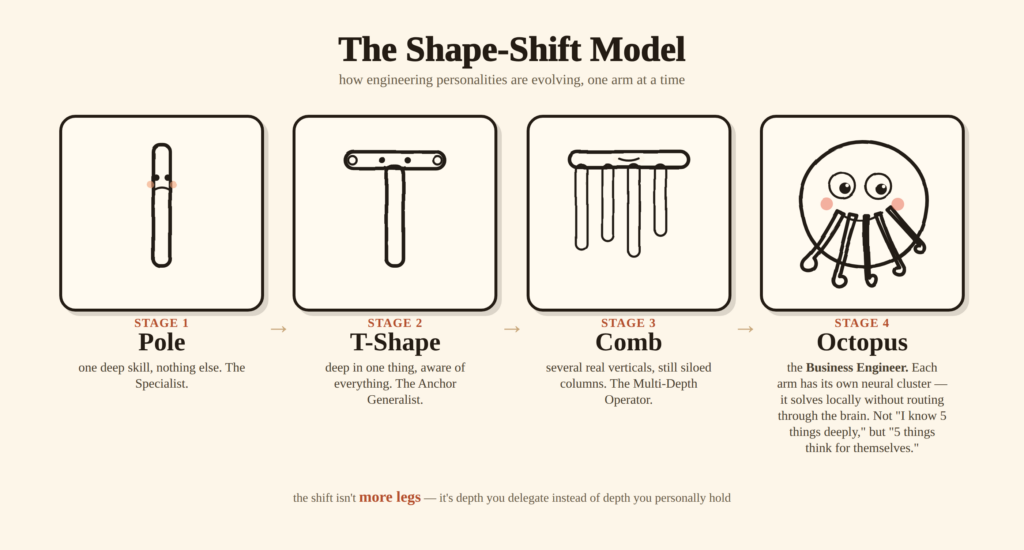
Pole. One deep skill, nothing else. The Specialist. Deep, but brittle the moment the domain shifts.
T-Shape. One deep skill plus broad awareness across everything else. The Anchor Generalist. This was the standard “good engineer” profile for most of the last fifteen years.
Comb. Several real verticals of depth, not just awareness of them. The Multi-Depth Operator. This is your staff engineer or platform lead who can go deep in infrastructure, data, and product, one at a time. The limitation isn’t the depth. It’s that each column is still separate, and integration between them has to be done manually, by one person.
Octopus. Central judgment, plus arms that act on their own. This is the shape I think we’re moving toward, and it’s not just “more legs.”
What Actually Makes an Octopus Different
Roughly two thirds of an octopus’s neurons live in its arms, not its brain. Each arm has its own neural cluster and can sense, decide, and act without routing every decision back through the head. The brain sets intent. The arms do the work and only report back what matters.
That’s a different operating model than “I’m skilled in five things.” It’s “five things can think for themselves, and my job is judgment and synthesis, not personally holding the depth.”
This is the shape AI is pulling engineers toward. Not because AI makes people smarter, but because it moves where the depth has to live. You don’t need to personally hold expert level depth in five domains anymore to operate at that level across five domains. You need the judgment to direct semi-autonomous work in each one, and the taste to know when to step in.
I’ve started calling this stage four person the Business Engineer. Their value isn’t how many domains they can personally go deep in. It’s how well they can orchestrate domains they no longer have to personally live inside.
The Same Shift, at the Org Level
I read a McKinsey piece on organizational reinvention recently that describes the same shift, just one layer up.
Their argument: organizations built their change management muscle around discrete, time bound initiatives with a defined end state. That world is mostly gone. What replaced it is continuous, overlapping disruption. Companies now run dozens or hundreds of initiatives they consider urgent, employees quietly opt out of the ones that don’t feel essential, and burnout is the residue of a system that never resolves into “done.”
That’s a Comb shaped org operating in an Octopus shaped environment. The columns are real. The depth is real. But everything still routes through central coordination, and central coordination can’t keep up with how much is now in motion at once.
The piece also names something worth flagging directly. It describes a growing AI divide among leaders themselves, not just in who uses AI tools, but in who understands what those tools can now do and how long tasks should take with them. That gap quietly erodes leadership credibility, and most employees notice before the leader does.
Their prescription is close to the Business Engineer role, applied at the top. Leaders shifting from directing work and supplying answers, to asking better questions and creating the conditions for learning. Less energy spent running the columns personally. More energy spent on judgment and direction for arms that can now act with real autonomy.
What This Means for How You Build Teams
A few things follow from this, if you’re building or leading an engineering org right now.
Leveling needs a fourth rung. Most career ladders reward Comb shaped depth. More verticals, more scope. They don’t have language yet for someone whose primary skill is directing semi-autonomous work across domains they don’t personally execute. On paper, that person looks less expert than the Comb. They’re not less valuable. They might be more valuable.
The bottleneck moves from expertise to judgment. When depth becomes delegable, to AI agents, internal tooling, automated pipelines, the scarce resource stops being “who knows the most” and becomes “who has the taste to catch when the arm got it wrong.” That changes what you’re actually hiring for and what a strong senior review looks like.
Org structure should mirror arm autonomy, not just team boundaries. A Comb structured org draws hard lines between verticals because that’s where the depth lives. An Octopus structured org can afford looser boundaries, because the arms, whether that’s teams, individuals, or agentic systems, are expected to solve locally and only escalate what actually needs central judgment. Over centralizing decisions here just recreates the same bottleneck McKinsey describes. Everything routes through one exhausted brain.
Learning speed becomes the real metric. If value is shifting from personal depth to orchestration quality, the asset worth protecting isn’t “how many experts we have.” It’s how fast people and systems can absorb new capability and put it to use. That’s a culture question before it’s a hiring question.
What I Actually Think This Means
The Comb shaped engineers and leaders who got orgs this far aren’t obsolete. But the shape that made them valuable isn’t the shape being rewarded most right now. That’s not a comfortable thing to say to someone who spent a decade building real depth across three or four domains. It’s still the honest read.
The organizations that figure out how to grow Business Engineers, and restructure around arms that think for themselves instead of columns waiting for instructions, are going to move faster than the Comb shaped orgs still routing everything through the center. Not because they’re smarter. Because less of the thinking has to travel through one brain before it becomes action.